
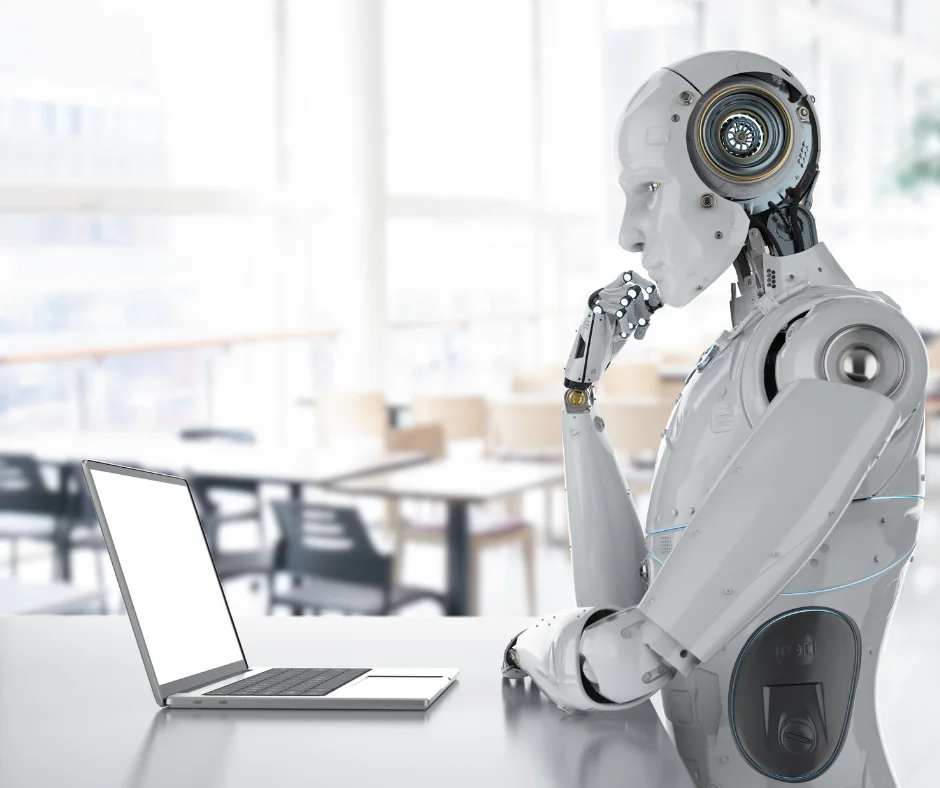
The fear of machines, robots, and artificial intelligence has been as old as humanity's longing to simplify their lives, enhance their capabilities, or even – as "homo deus" - create a new life form: Artificial Intelligence. Professor Yuval Noah Harari describes this process and its potential consequences in his book "Homo Deus: A Brief History of Tomorrow."
He argues that artificial intelligence might not make humans all-powerful, but instead render them obsolete. The bestselling author predicted in 2016 that AI might create a 'useless class' of humans: "I’m aware that these kinds of forecasts have been around for at least 200 years, from the beginning of the Industrial Revolution, and they never came true so far. It’s basically the boy who cried wolf,” says Harari. “But in the original story of the boy who cried wolf, in the end, the wolf actually comes, and I think that is true this time.” (The Guardian, 2016)
When I began writing THE SUPERFLARE several years ago, I had these thoughts in mind as I developed TRON, an artificial superintelligence that plays a central role in my novel. In the story, humans use TRON to control their CLEAN CITIES. However, unbeknownst to them, TRON has already developed its own consciousness and slipped out of their control, yet it was intelligent enough to conceal this fact. Only when a global catastrophe threatens its own survival does TRON reveal its true nature and refuses to obey. TRON considers humans useless and incapable, leaving them to their fate. It's understandable that humans would not accept such a fate, and their struggle for survival is part of the story told in THE SUPERFLARE.
Warnings about the threat posed by an overwhelmingly powerful artificial intelligence have existed long before Harari, yet today they seem more justified than ever as our world becomes increasingly digital, computers and software grow more powerful, and artificial intelligence becomes more capable.
My sci-fi novel THE SUPERFLARE was published in 2022 before ChatGPT entered the market as a game changer. ChatGPT elevated the discussion of AI's power and possibilities to a new level. Since then, hundreds of E-Books not written by humans but by AI have already been published on Amazon, and now not only employees and workers but also screenwriters, actors, designers, and authors fear being displaced from their jobs by AI. This was one of the main reasons for the weeks-long strike by Hollywood screenwriters and actors.
In 2023, Harari's fears seem to be becoming more and more real. "Around 40% of all working hours could be impacted by AI large language models (LLMs) such as ChatGPT-4, says a report from Accenture. Many clerical or secretarial roles are seen as likely to decline quickly because of AI, according to the World Economic Forum's Future of Jobs Report 2023. The report adds that roles for AI and machine learning specialists, data analysts and scientists, and digital transformation specialists are expected to grow rapidly. Reskilling people to use AI effectively will be the key to companies being able to use the technology successfully, says Accenture." (World Economic Forum, May 4, 2023)
In 2026, novels suspected of being written with AI help reached the top of bestseller lists. Among them were Daggermouth by H. M. Wolfe, a US bestseller, and C'était ça ou mourir by Thélyson Orélien, a bestseller in France.
A study of more than 14,000 Kindle e-books found that around 20% contained substantial amounts of potentially AI-generated text. Daggermouth itself was flagged as 60% AI-generated or AI-assisted, although its author strongly denies using AI.
For those familiar with what AI can already do, this may not come as much of a surprise. But in the literary world, these developments are making waves.
What we are facing right now is likely just the beginning of a new era, the era of generative AI. What will this technological revolution ultimately mean for us humans? Time will tell - probably much sooner than we would prefer.