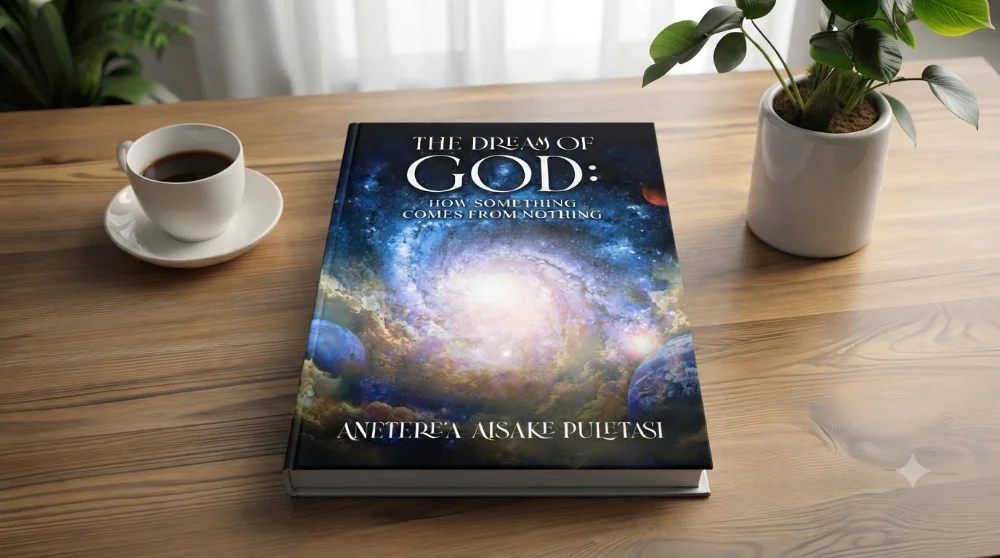
Modern spiritual literature often tries to answer questions that sit beyond the reach of ordinary language. Some books approach these mysteries through religion, others through science, and some through philosophy alone. The Dream of God: How Something Comes From Nothing by Anetere’a Aisake Puletasi, writing under the name Son of Man, attempts something more ambitious. It tries to connect all three.
At the center of the book is a striking idea: darkness was never empty. Instead, it was the original field of possibility from which existence emerged. Rather than treating “nothingness” as absence, the book presents it as a living source of infinite potential. This perspective shapes every chapter and gives the work its unique philosophical identity.
For readers interested in spiritual books, philosophical literature, cosmology and consciousness, or thoughtful book analysis, this work offers more than abstract speculation. It presents a deeply reflective exploration of creation, awareness, and the nature of reality itself. While the ideas are expansive, the writing remains grounded in a human search for meaning.
What This Book Believes
Nothingness as Potential, Not Emptiness
The foundation of The Dream of God: How Something Comes From Nothing rests on a reversal of one of humanity’s oldest assumptions. Traditionally, nothingness is imagined as empty space, a void without energy, intention, or form. Son of Man challenges this interpretation directly.
In the book’s worldview, darkness is not the absence of light but the condition that makes light possible. Before time, before matter, before the Big Bang itself, there existed a form of infinite potential waiting to unfold. This philosophical approach places the book within a growing conversation around metaphysical thought, existential philosophy, and modern spiritual inquiry.
What makes the argument compelling is that it avoids sounding purely mystical. Instead, the author frames darkness as a creative principle. The idea becomes less about religion in a traditional sense and more about understanding existence as layered consciousness.
Readers looking for a typical self-help structure may find the book unconventional. However, those drawn to thought-provoking books and reflective spiritual writing will likely appreciate its willingness to explore difficult questions without reducing them to simple answers.
Reality as a Divine Dream
Another major concept in the book is the idea that reality itself may be a dream unfolding within divine consciousness. This metaphor shapes much of the narrative and philosophical direction of the text.
According to Anetere’a Aisake Puletasi, existence is not random chaos but an intentional unfolding of awareness. Human beings are not separate from creation; they are participants inside it. The “dream” described in the book is not illusion in the ordinary sense. Instead, it represents a living relationship between consciousness and reality.
This idea gives the book emotional depth beyond abstract philosophy. It invites readers to think about identity, purpose, and perception differently. The universe becomes less mechanical and more intimate.
For readers interested in consciousness studies, spiritual awakening books, or philosophical book reviews, this perspective is likely to resonate strongly. Even readers who disagree with the conclusions may find themselves reflecting on the questions long after finishing the final chapter.
How the Book Makes Its Case
Science and Spirit as Reflections
One of the more interesting aspects of The Dream of God: How Something Comes From Nothing is its attempt to bridge the divide between scientific curiosity and spiritual intuition.
Rather than positioning science and spirituality as opposing forces, Son of Man treats them as reflections of the same search for truth. The book repeatedly returns to questions science has not fully answered: What existed before the universe began? What is consciousness? Why does existence emerge at all?
These questions are approached with philosophical openness instead of rigid certainty. The author does not attempt to dismiss science. Instead, he suggests that scientific inquiry may eventually point toward deeper spiritual realities.
This balanced approach gives the work broader appeal. Readers who enjoy science and spirituality discussions, cosmology books, or speculative philosophical writing may appreciate how the book encourages dialogue instead of conflict.
Importantly, the text does not rely heavily on technical language. The concepts remain accessible even when discussing complex ideas. That accessibility helps maintain the book’s reflective tone without overwhelming the reader.
Ancient Wisdom as a Compass
The influence of ancient spiritual traditions can also be felt throughout the book. While Anetere’a Aisake Puletasi does not confine his thinking to one religious framework, he draws from timeless themes found across spiritual history: creation emerging from darkness, unity beneath separation, and consciousness existing beyond material form.
This gives the work a universal quality. Readers from different backgrounds may recognize echoes of mystical traditions, philosophical teachings, and symbolic interpretations of creation myths.
The book’s strength lies in how it uses these influences as guidance rather than authority. Ancient wisdom becomes a compass for exploration instead of a strict doctrine.
This approach helps the book stand apart from more rigid spiritual texts. It feels exploratory, reflective, and open-ended. For readers searching for literary philosophy, spiritual insight, or meaningful book recommendations, the text offers an experience centered on contemplation rather than instruction.
What Works, What Lingers
A Fresh Metaphor for Creation
The most memorable aspect of The Dream of God: How Something Comes From Nothing is undoubtedly its central metaphor: darkness as the first seed of existence.
It is a simple but powerful image. Instead of portraying darkness as fear or emptiness, the book reframes it as the beginning of possibility. This shift changes how readers may think about uncertainty, silence, and the unknown.
The metaphor works because it connects cosmic ideas to human experience. Moments of confusion or isolation become symbolic spaces where transformation begins. In this way, the philosophical themes gain emotional relevance.
The writing style also supports the book’s reflective nature. Son of Man writes with clarity while still preserving a sense of mystery. The language often feels meditative, encouraging readers to pause and think rather than rush through the material.
For fans of philosophical books, spiritual literature, and modern metaphysical writing, this metaphor alone may make the book worth exploring.
Questions the Book Leaves Open
Despite its strengths, the book intentionally leaves many questions unresolved. Some readers may appreciate this openness, while others may want more concrete explanations.
The philosophical nature of the work means it operates more through reflection than evidence-based argument. Readers looking for detailed scientific analysis may find parts of the book abstract. Likewise, those expecting traditional religious structure may discover that the text moves beyond conventional doctrine.
Yet this openness may also be part of the book’s purpose. Anetere’a Aisake Puletasi seems less interested in delivering final answers than in encouraging deeper inquiry.
The unanswered questions become part of the reading experience itself. The book lingers because it invites contemplation rather than closure.
The Seed Has Been Planted
The Dream of God: How Something Comes From Nothing by Son of Man is ultimately a meditation on origins, consciousness, and the hidden possibilities within darkness. It combines spiritual reflection, philosophical questioning, and cosmological imagination into a work that feels both personal and expansive.
Its greatest strength lies not in proving a theory, but in reshaping the way readers think about existence. By presenting darkness as the first creative force rather than a void, the book offers a perspective that is both symbolic and deeply human.
For readers interested in literary analysis, spiritual philosophy, metaphysical books, and reflective explorations of reality, this is a work that leaves a lasting impression. Whether one fully agrees with its ideas or not, the questions it raises continue to echo after the final page.
And perhaps that is the book’s true achievement. It does not simply offer answers. It plants a seed of thought and leaves the reader to discover what may grow from it.